7 Small Ways Nature Can Deepen Your Divination Practice
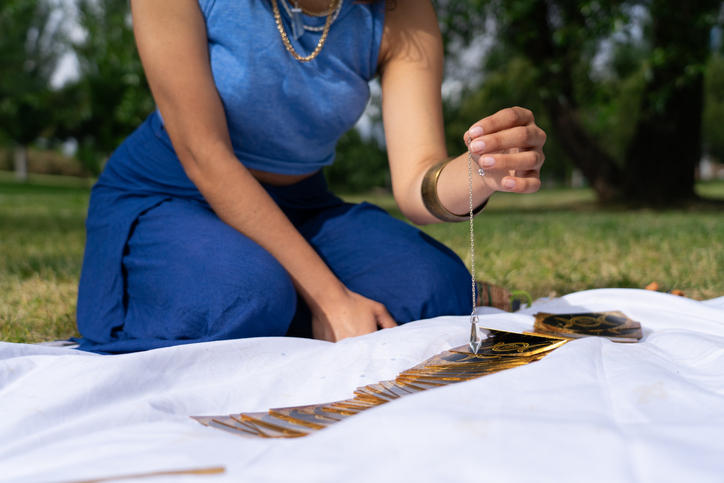
Many of us first learn divination by focusing on the tool in front of us: a tarot deck, runes, a pendulum, or set of oracle cards. We learn the meanings, practice our spreads or casting methods, and begin building a relationship with symbols. This is important work, and a good diviner needs practice and fluency with their chosen tools.
But divination doesn't happen in a vacuum.
Every reading takes place somewhere. You may be sitting at your kitchen table, walking through a city park, lying awake in a hotel room, or pulling a card before an important conversation. The place itself matters. The land, the room, the weather, the ancestors and histories of that location, and your own relationship to where you are can shape the quality of what you receive.
In an animist or polytheist worldview, the world around us is never just scenery. It is alive with presences. Rivers, trees, stones, animals, winds, household spirits, ancestors, and spirits of place may all be part of the wider field of relationship in which divination occurs. However, this does not mean we see every falling leaf or passing bird as a dramatic omen. Good divination requires discernment and humility. When we divine, we are not only listening inwardly to our higher self or intuition; we are also learning to listen outwardly, to the living world around us.
Ancient divinatory traditions understood this well. In pre-Christian Greece, the oracle at Delphi was not located just anywhere; it belonged to a specific mountain, a sacred landscape and spring, and a long history of divine guidance. At Dodona, one of the oldest Greek oracles, priests and priestesses listened for Zeus in the rustling leaves of the sacred oak or in the sounds of birds. Across many cultures, caves, mountains, crossroads, and rivers have been understood as places where communication between the human and more-than-human worlds may be especially clear.
This is one reason nature-led divination can be so powerful: it gives us more tools to listen with—more words in our vocabulary. Instead of treating divination as a closed conversation between one person and one tool, we recognize it as part of a larger web of connection. The tarot cards we pull may answer one layer of our question, while the wind outside as we interpret them may answer another. The sudden appearance of a bird, a phrase overheard on the sidewalk, or the feeling in your body when you enter a particular place can all help refine the message, when they are approached (and interpreted!) with care.
Place also teaches us appropriateness. What works beautifully in one setting may only lead to confusion somewhere else. On a walk in a park, you might ritually ask a question and watch the direction birds fly above you as part of a formal omen walk. While on vacation, you might make a simple offering and ask for a divinatory dream that night. Divination works best when we stop forcing one method onto every situation and begin asking: Where am I? Who and what is here with me? What kind of listening is best for me here?
This is the heart of the nature-led approach I teach in The Diviner's Path: divination is not only about getting answers. It's about finding out what your questions really are, how best to approach them, and how to receive answers holistically: with your intuition, tools, helping spirits, and the living world around you.
Here are seven small ways to begin today.
1. Take a Simple Omen Walk
One of the most direct ways to bring divination into relationship with the living world is to take an omen walk: a short, intentional walk during which you ask a clear question and pay attention to what the world presents in response.
In some locations and seasons, this may include watching birds. Birds have been treated as messengers in many divinatory traditions, in part because they move between earth and sky. In a large park, quiet field, or another appropriate outdoor space, you might ask a simple question and observe the direction birds fly, whether they cross your path, call out, or stay silent. Their movement becomes part of the symbolic language of the reading.
This doesn't mean every bird or animal is a sign. Clear ritual openings and closings are important. The full ritual structure I use (including how to define the space, timing, and interpretation for omen walks) is included in The Diviner's Path. However, you can always begin quite simply: choose an appropriate route or natural place, set a short time limit (5-10 minutes is best), ask one clear question aloud, walk slowly, and notice what stands out. When you finish, write down your observations before deciding how they relate to your question.
At its best, an omen walk teaches one of the most important skills a diviner can develop: how to pay attention, and listen without forcing.
2. Notice the Plants, Trees, and Flowers that Catch Your Attention
Another simple way to listen to the living world is to pay attention to the plants, trees, and flowers that seem to call for your notice. This kind of listening is often slower than pulling a card or casting a chart, and it may not begin with a neatly worded question. Still, it is also an important part of nature-based relationship and knowledge building.
This "noticing" may happen dramatically, as with a tree that stops you in your tracks by the sound of the wind through its leaves, or more quietly, such as the same plant appearing along your path for several days, seeming to say "hello" as you pass. It could be a flower blooming unexpectedly, or a street tree that draws your eye whenever you pass it.
Plants teach through presence, timing, and pattern. A dandelion pushing through pavement speaks differently than an old Yew tree at the edge of a cemetery, and their meanings can be more than what's found in traditional magical correspondences, though those are great starting points for understanding. Communication with these beings is also found in where they grow, when they appear, and what they stir in you.
If a plant or tree catches your attention, begin with curiosity, and find out what it is. Is it native to the place, or has it traveled there through human hands? Is it medicinal, poisonous, edible, protective, thorned, flowering, fruiting, or returning after winter?
Plants remind us that wisdom is not always sudden or dramatic. Sometimes it grows quite slowly, waiting for us to notice.
3. Pay Attention to the Feeling of a Place
Before taking out your runes or tarot cards to divine, or starting an omen walk, it helps to ask where you are, and how you feel in your body.
Each place has its own presence that can influence us. Some places invite stillness and contemplation, while others might feel busy, restless, heavy, or bright. Part of becoming a skilled diviner is learning to notice the character of a place before you ask your questions within it.
Of course, you don't need to know the spiritual history of every location before you pull a card. Sometimes you'll simply have to ask your question with the tools and circumstances available to you, because the need is clear and time is limited. Still, in new places, the best practices are often simple: take a few breaths, acknowledge the room (or place) and the land beneath you, and use a familiar tool for a brief check-in before divining on your larger question.
Your body will often notice the feeling of a place before your mind can explain it. Did you relax when you entered the room? Did your shoulders tighten? Has your breathing changed? Did you feel drawn to a particular window, tree, or area?
4. Greet Spirits of Place with a Simple Offering
When you arrive somewhere new, consider pausing to greet the spirits of place before you begin asking for any guidance. This is especially important when traveling, or doing divination for the first time in a space. A brief moment of acknowledgment helps you orient yourself spiritually, rather than treating the place you find yourself in as an empty canvas.
Spiritual offerings don't necessarily need to be complicated. You can silently introduce yourself; offer a few words of gratitude; recite a short poem; hum or sing quietly; pick up litter from the ground; or pour a little clean water for a shrub, tree, or patch of earth nearby. Wherever you are, always keep offerings safe and appropriate.
Keep in mind that offerings are not about buying favor or demanding messages. We are acknowledging that we are always a part of much larger webs of community, which can help our readings come through with greater clarity.
5. Practice Kledonomancy: Listen for Overheard Words
Sometimes the living world speaks through language. Kledonomancy is divination through chance words, sounds, or phrases.
In ancient Greece, one form of this practice involved a ritual "stopping" and "unstopping" of the ears. A person would ask a question at a temple of Hermes, cover their ears as they left the sacred space, and then uncover them in a busy marketplace nearby, listening carefully to the first words they heard. Hermes, as a God of messages, journeys, and communication is a natural patron for this divination.
You can easily adapt this practice in the modern world: In a safe place, ask a clear question. Then, ritually "stop" your hearing for a moment. You might cover your ears with your hands, put in foam earplugs, or use noise-canceling headphones while you hold the question in your mind. When you are ready (and in a place that's relatively "noisy" with chatter, with other people nearby), remove them and listen for what you hear next.
Whatever you hear, write it down, reflect on it later, and, if needed, check your interpretation using other forms of divination, and in conversation with trusted friends.
Remember to use common sense and stay safe with this practice: never block your hearing while crossing streets, walking alone in an unfamiliar place, driving, or anywhere you need full awareness of your surroundings.
6. Use Favorite Tools for Quick Confirmation
Nature-led divination does not mean setting aside other tools you already love. Tarot cards, runes, pendulums, and alphabet stones work beautifully alongside omen walks, plant messages, dreams, and kledonomancy. A familiar tool can be especially helpful when you want to clarify your interpretation of something you noticed in the natural world.
This is where a small pendulum, or a one-card or one-rune pull can be especially useful. After an omen walk, for example, you might ask: Was that bird encounter connected to the question I asked? or, Is this sign asking me to act now, or wait and have patience? Pendulums are excellent for simple yes/no clarifications, but only if you practice with one regularly, and know how it usually responds to you.
In all divination, remember that quick check-ins should never become compulsive checking. If you keep asking the same question because you dislike the answer, or if you are using a tool repeatedly to avoid making decisions, then it might be feeding into anxiety or fear, rather than supporting your own internal discernment. Healthy divination should contribute to feelings of balance, and to helping you develop trust in your ability to make decisions.
7. Ask for Guidance Through Dreams
Not every answer arrives while we are awake and actively looking. Sometimes the clearest guidance from the world around us comes later, after the mind softens and the deeper layers of awareness begin to speak. Dreams have long been used as a divinatory path, and they can be especially powerful when combined with place-based practice.
At the end of a day of listening—to birds, plants, overheard words, the feeling of a place, or your tarot cards—you might ask for further guidance through your dreams. Before bed, write down one simple question on a piece of paper, such as: What do I need to understand about the message I received today? or, What is the next step? You may address the question to your higher self, your ancestors, a deity, a guardian spirit, or the spirits of the place where you are. Place the piece of paper under your pillow before you go to sleep.
I love to use this form of divination when I'm away from home, since even if I can't spend as much time outside, I can still pause and invite a dream that will help me connect to things I need to know in the moment.
With all dreamwork, record what you remember as soon as you wake up, using a pen and paper, your phone, or by making a quick audio recording of what you remember. Pay attention to images, colors, emotions, animals, phrases, and anything that felt especially vivid. Over time, patterns in how your dreams relate to questions and situations will become clear.
"One thing I've learned in the woods is that there is no such thing as random. Everything is steeped in meaning, colored by relationships, one thing with another."
—Robin Wall Kimmerer, Braiding Sweetgrass
Divination is made up of countless beautiful artforms, traditions, languages, and symbols. For decades, I have seen how nature helps connect them all, making it easier for us to understand and respond to the guidance we receive.
Divination flows best when we remember that we are never practicing it in isolation. Every reading happens under a particular sky, on particular land, and within a web of ancestors, plants, people, animals, weather, and meaning. The more we reach out to listen with intent, recognizing the patterns unfolding around us, the more our divination becomes not just a search for answers, but a joyful path of connection. In The Diviner's Path, I explore these practices in greater depth, with rituals, guided meditations, and exercises for working with tarot, runes, omens, dreams, and many other tools.
Wherever you are, begin there. Ask your questions, listen deeply, and let the world answer you.

About JoAnna Farrer
Related Products

is subject to certain Terms and Conditions